
EC Cleaners Network · Kitchen Extract Problems
If grease seems to return very quickly after a kitchen extract clean, do not assume either that the clean failed or that the kitchen simply needs cleaning more often.
The right question is why the grease has returned. Heavy cooking, increased operating hours, menu changes and a high accumulation rate may explain it. The previous cleaning scope, inaccessible sections, exclusions and post-clean evidence should also be checked before the interval is changed.
Has grease returned sooner than expected?
Send the latest cleaning report, last cleaning date, photographs, current operating hours and any recent menu or equipment changes. Include any access limitations or exclusions recorded during the previous clean.
Search and Submit Ltd uses your details to respond and coordinate the enquiry, including sharing relevant information with appropriate independent specialists. Read our Privacy Policy. Please omit unrelated personal or sensitive information.
Why can grease return quickly after kitchen extract cleaning?
Kitchen extract systems continuously draw grease, oil vapours and airborne particulates through the extract route during cooking. BESA notes that this exposure causes grease deposits to build up on internal surfaces, and that the rate of accumulation can increase in kitchens operating for long hours or producing a high grease load.
A fast return of visible grease can therefore be genuine new accumulation. It can also indicate that part of the original contamination remained outside the completed cleaning scope or in a section that could not be reached.
Rapid grease return is a reason to review both the kitchen and the previous clean.
Read the parent guide to commercial kitchen extraction problems →
Seven reasons grease may appear to return quickly
High grease production
A kitchen using grease-intensive cooking methods can begin building deposits again quickly even after a thorough clean.
Long operating hours
More hours of active cooking mean more contaminated air passing through the extract route. BESA uses operating hours as one of the baseline factors for cleaning frequency.
Menu or equipment changes
A changed menu, additional fryers, grills or other equipment can alter the amount and character of grease entering the system.
The cleaning interval is no longer suitable
If operating conditions have changed or grease is accumulating faster than before, the existing return interval may need to be reviewed.
Part of the system was excluded
A report may show that some sections were not included in the cleaning scope. Contamination in those areas can remain after the completed work.
Part of the system was inaccessible
If the contractor could not reach a section of ductwork, the condition of that section remains unresolved unless access is later provided.
The post-clean evidence is unclear
If photographs, measurements, cleaned areas and exclusions are difficult to relate to the system, the client may not be able to establish what was actually completed.
Does rapid grease return mean the previous contractor did a poor job?
Not necessarily. A busy commercial kitchen can start accumulating fresh grease immediately after cleaning. BESA states that actual cleaning frequency should be determined using the type of cooking, seasonal menu variation, grease accumulation rate and deposit thickness testing, rather than relying only on a fixed calendar interval.
At the same time, it is reasonable to review the previous report if the condition appears inconsistent with how recently the system was cleaned. The aim is to establish the facts, not to assume either contractor failure or unusually heavy kitchen use.
Start with the previous cleaning scope
The words “kitchen extract clean” can hide very different scopes. One job may cover the canopy and accessible ductwork. Another may include the full intended extract route, fan and discharge, subject to access.
Check what the contractor actually included. If the scope stopped before an inaccessible riser, roof section, fan or another part of the system, contamination in that area may still have been present after the visit.
Do not compare the date of the clean with the current condition until you know what was actually cleaned.
What should the post-clean evidence show?
BESA’s current public guidance says post-clean verification should include before-and-after photographs from matching positions, DTT or WFTT measurements, a written summary of work completed, access limitations or areas requiring attention, cleaned-area information and a hygiene certificate.
For the client, this evidence should make it possible to answer three practical questions:
- What was cleaned? The system and cleaned sections should be identifiable.
- What could not be cleaned? Access limitations and exclusions should remain visible.
- What did the system look like afterwards? Photographs and measurements should support the recorded outcome.
Inaccessible ductwork can make the problem look as though it has returned
If one part of the extract route was cleaned but another section could not be accessed, the remaining contamination has not disappeared. A later visual problem may therefore be connected with contamination that was never removed from the inaccessible section.
HSE guidance says commercial kitchen ductwork should have suitable access to allow regular cleaning and prevent the accumulation of fat. BESA likewise emphasises comprehensive access through the duct system for effective cleaning.
Where access was the reason work could not be completed, the long-term answer may be to resolve the access problem rather than repeatedly clean only the reachable sections.
Could the kitchen simply be producing grease faster?
Yes. The cooking operation may have changed since the interval was first established. Longer hours, higher production, more intensive frying or grilling, additional equipment or a changed menu can alter the grease load substantially.
BESA’s current guidance says cleaning frequency should be regularly reviewed and should consider cooking type, seasonal menu changes, grease accumulation rate and deposit thickness testing. That is why the correct response to fast grease return is not automatically to select a shorter interval without reviewing the evidence.
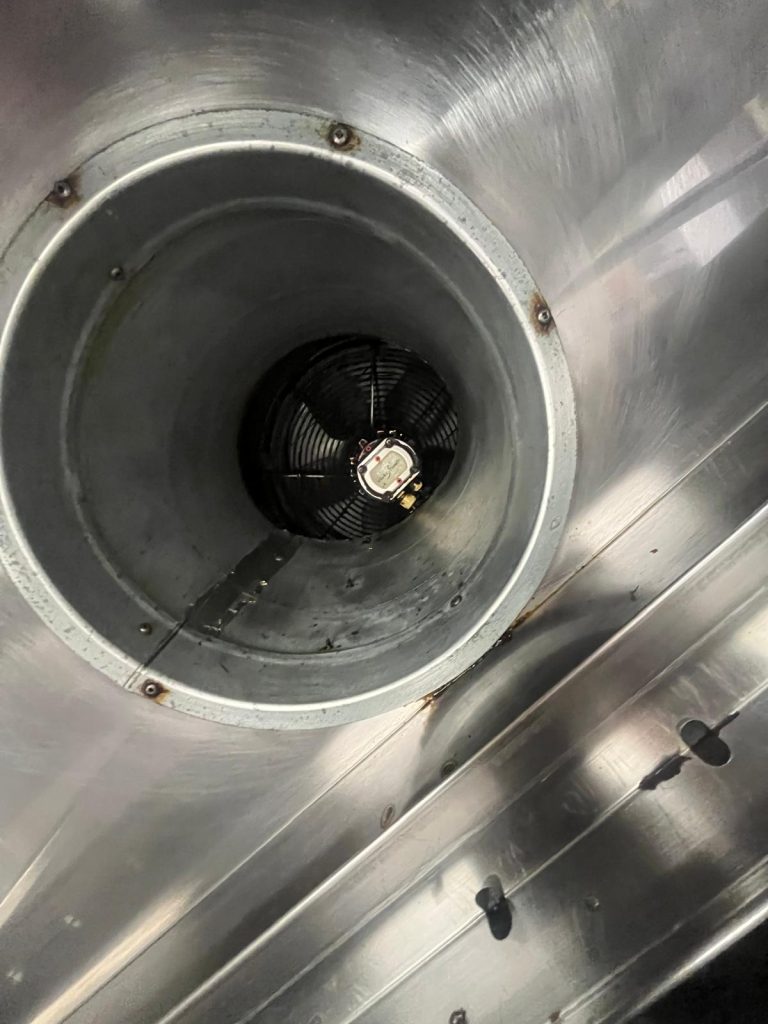
Historic EC Cleaners project imagery illustrates internal kitchen extract ductwork. It is not presented as evidence of rapid grease return or an incomplete clean at the photographed premises.
What should you compare before changing the cleaning interval?
- Last cleaning date. Confirm when the work was actually completed.
- Previous cleaning scope. Establish which components and duct sections were included.
- Access limitations. Check whether any areas remained inaccessible or excluded.
- Post-clean photographs. Compare attributable images with the current condition where possible.
- Deposit measurements. Review representative readings and their locations if available.
- Operating changes. Check for longer hours, greater production, new equipment or menu changes.
- Current evidence. Record where grease has reappeared and whether the problem is local or seen across several parts of the system.
When should the cleaning interval be reviewed?
If the evidence shows that fresh grease is genuinely accumulating faster than the current maintenance regime can control it, a competent contractor or professional may recommend a shorter interval.
If the issue is incomplete scope or poor access, simply shortening the interval may repeat the same problem more frequently. The unresolved section should be addressed so the maintenance programme reflects the actual system.
A shorter interval is useful only when the maintenance scope is capable of reaching the areas that need maintaining.
Which route may be appropriate?
Fresh grease accumulation
If the kitchen is genuinely accumulating grease quickly, review the operating conditions, current interval and contractor recommendation.
Incomplete or unclear cleaning scope
If the previous report does not make the cleaned areas and exclusions clear, organise the evidence before issuing another instruction.
Inaccessible sections
If parts of the system could not be reached, access remediation may be needed before the next full maintenance cycle.
Visible grease leakage
If grease is leaking or dripping outside the system, investigate the source and wider internal condition rather than treating the surface only.
Repeat cleaning requirement
If a further clean is required, define the intended system scope and expected post-clean evidence before appointment.
Contractor appointment
Where the issue is recurring, contractor capability, access planning and evidence quality become especially important.
Related kitchen extract guidance
This page focuses on rapid grease return after cleaning. The related pages cover grease accumulation rate, cleaning frequency, post-clean evidence and visible leakage.
Grease returning after kitchen extract cleaning: frequently asked questions
Why does grease come back quickly after kitchen extract cleaning?
There is no single cause. Grease can accumulate quickly because of heavy or grease-intensive cooking, increased operating hours, a changed menu, short cleaning intervals that no longer match the kitchen, incomplete scope, inaccessible sections, or contamination left in parts of the system that were not effectively cleaned.
Does grease returning quickly mean the previous clean was poor?
Not automatically. A rapid return of grease can reflect a high accumulation rate in a busy kitchen. It can also justify reviewing the previous scope, access, photographs, deposit readings and exclusions to confirm what was actually cleaned.
Can inaccessible ductwork make grease appear to return quickly?
Yes. If part of the extract route could not be accessed or cleaned, contamination may remain in those sections. The report should keep that limitation visible so the client does not assume the full system was addressed.
Can a change in menu make grease build up faster after cleaning?
Yes. BESA identifies cooking type and seasonal menu variation as factors that can affect the appropriate cleaning frequency. A change in cooking process can alter how quickly grease accumulates.
Should I shorten the cleaning interval if grease returns quickly?
Possibly, but the reason should be established first. Review the operating profile, cooking type, inspection findings, deposit measurements, access and the previous cleaning scope before the competent contractor or professional recommends a revised interval.
What should I check in the post-clean report?
Check the system identity, cleaning scope, before-and-after photographs, representative DTT or WFTT readings where used, access limitations, exclusions, outstanding actions and the recommended return interval.
What should I send if I am concerned that grease has returned too quickly?
Send the latest cleaning report, post-clean photographs, last cleaning date, current operating hours, recent menu or equipment changes, any access limitations and photographs of the current condition where safe to obtain.
Has grease returned sooner than expected after the last clean?
Send the latest cleaning report, post-clean evidence, current condition and operating information. EC can help organise the facts so cleaning frequency, previous scope, access and evidence are reviewed separately before the appropriate independent specialist is approached.
Responsibility statement:
EC Cleaners Network is operated by Search and Submit Ltd. Search and Submit Ltd does not inspect, clean, test, survey, design, remediate, certify or technically approve kitchen extraction or ventilation systems. Independent appointed contractors and competent professionals remain responsible for technical assessment, safe working, quotations, physical delivery, reporting, certification and professional conclusions within their appointed scope.
TR19® Grease and TR19® Air are BESA specifications. References are descriptive and no BESA endorsement of or affiliation with EC Cleaners Network is claimed.