
EC Cleaners Network · Kitchen Extract Questions
Two kitchens can operate for the same number of hours and still accumulate grease at very different rates.
Operating hours matter, but they are only part of the picture. BESA advises that cleaning frequency should also consider the type of cooking, seasonal menu changes, the condition of the system, the actual grease accumulation rate and the results of deposit thickness testing.
Has the kitchen changed since the cleaning interval was set?
Send the site location, current cleaning interval, last report and any recent change in opening hours, cooking volume, equipment or menu. EC can help organise the information before the requirement is taken to an appropriate independent specialist.
Search and Submit Ltd uses your details to respond and coordinate the enquiry, including sharing relevant information with appropriate independent specialists. Read our Privacy Policy. Please omit unrelated personal or sensitive information.
Why does grease build up faster in some kitchen extract systems?
Grease reaches the extraction system as cooking releases oil vapour, grease-laden aerosols and airborne particulates. BESA notes that these contaminants are continuously drawn through commercial kitchen extract systems during operation and accumulate on internal surfaces.
The rate of accumulation is not determined by opening hours alone. A kitchen that produces large amounts of grease during a shorter service can create a different extract loading from a kitchen that operates for longer but uses less grease-producing cooking methods.
Cleaning frequency should reflect the kitchen that is actually operating, not simply the timetable that was inherited.
Read the full kitchen extract cleaning-frequency and scheduling guide →
The main factors that can increase grease accumulation
Cooking method
The type of cooking affects the amount and character of grease, oil vapour and particulates entering the extract system. BESA specifically identifies cooking type as a factor when deciding the appropriate cleaning frequency.
Cooking volume
A busier kitchen can put more contaminant through the extraction system even when the published opening hours have not changed. Increased covers, production volume or service intensity should prompt a review of the existing maintenance assumptions.
Longer operating hours
More hours of active cooking can increase the amount of grease carried through the system. BESA uses daily operating hours as a baseline for cleaning-frequency guidance, but it also says the interval should be adjusted for other risk factors.
Menu changes
BESA specifically refers to seasonal menu variation when discussing cleaning frequency. A change in the food being produced can alter the grease load even when the kitchen layout and opening times remain the same.
System condition
The condition recorded during inspection is part of the frequency decision. A system that is accumulating deposits faster than expected may need a shorter interval or further investigation.
Measured accumulation rate
Deposit thickness readings provide objective evidence of how much contamination is present at measured points. Repeated readings can help show whether the current interval is controlling grease effectively.
Why cooking type matters more than a simple hours table
The familiar operating-hour bands are useful as a starting point, but they should not be read as a complete risk assessment. BESA describes them as minimum cleaning-frequency recommendations and says more frequent cleaning may be required depending on cooking type, system condition and the findings of fire-risk or insurance assessments.
This is why two sites both operating for twelve hours a day can still need different maintenance regimes. The relevant question is not only how long the kitchen is open, but what happens during those hours and what the inspection evidence shows.
Can filter maintenance prevent grease reaching the ductwork?
Filter maintenance is important, but it does not remove the need to inspect and clean the wider extract route. BESA states that no filter is completely effective and that grease and oil deposits can still affect internal surfaces throughout the extraction system.
For the client, that means a clean-looking filter bank or canopy should not be treated as proof that the ductwork, fan and discharge sections are in the same condition.
How do you know whether the current cleaning interval is still working?
The best evidence comes from comparing the maintenance plan with what the system is actually showing at inspection.
- Check the previous interval. How long had the system been operating since the last clean?
- Check whether the kitchen changed. Look for longer hours, greater volume, different equipment or a changed menu.
- Review the inspection findings. What did photographs and condition observations show?
- Review deposit measurements. Where readings were taken, did they show faster or slower accumulation than expected?
- Check access. Was enough of the system available for the evidence to be representative?
- Review recommendations. Did the contractor or professional propose a different return interval or further action?
A maintenance interval should be capable of being explained from the available evidence. If the kitchen has changed materially, carrying forward the old interval without review can leave the schedule disconnected from the actual operating risk.
Grease build-up can be uneven across the system
An extract system should not be judged from one visible point. Measurements and photographs are taken at representative locations because contamination can vary across the route.
If part of the system could not be reached, the condition of that section remains uncertain. Satisfactory evidence from accessible areas does not remove a recorded access limitation elsewhere.
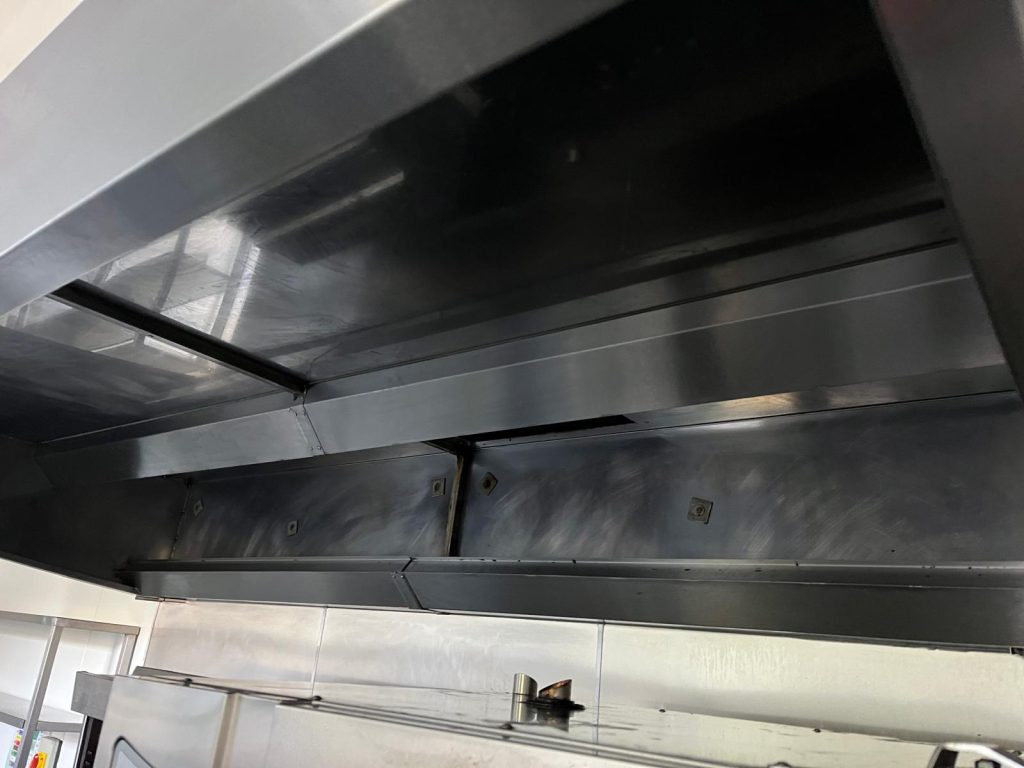
Historic EC Cleaners project imagery shows the wider extract-system context. It is not presented as a current condition assessment or as evidence of a particular grease level.
When should a change in kitchen operation trigger a review?
A review is sensible when the conditions used to set the existing interval no longer describe the kitchen. Examples include a substantial increase in trading hours, a busier service pattern, a change in menu, new cooking equipment or previous inspection findings that show the system is accumulating grease faster than expected.
The purpose of the review is not to guess a new frequency from one change. It is to put the updated operating information alongside inspection findings, deposit measurements, access and the previous maintenance record so the competent contractor or professional can make a better-informed recommendation.
A change in operation is a reason to review the interval, not an automatic instruction to choose a particular frequency.
What should a specifier or facilities team keep on record?
Operating profile
Typical cooking hours, service pattern and any material change in kitchen use.
Cooking activity
The broad cooking processes and any menu or equipment changes that could alter grease production.
Inspection evidence
Condition reports, photographs and representative deposit measurements where available.
Cleaning history
Previous cleaning dates, scope, exclusions and the evidence returned after each visit.
Access limitations
Any sections that could not be inspected or cleaned and what is being done to resolve them.
Frequency rationale
The reason the current inspection or cleaning interval was selected and any recommendation to change it.
Continue the cleaning-frequency cluster
This page explains why grease can accumulate at different rates. The related pages cover the wider scheduling regime, warning signs, inspection and deposit measurements.
Grease build-up and cleaning frequency: frequently asked questions
Why does grease build up faster in some commercial kitchen extract systems?
Grease accumulation can increase because of the type of cooking, the amount of cooking carried out, operating hours, seasonal menu changes, the condition of the system and the actual accumulation rate shown by inspection and deposit measurements. BESA advises that these factors should be considered when setting cleaning frequency.
Does heavy frying mean the extract system may need cleaning more often?
It can. Cooking methods that generate more grease and oil vapour can increase the contaminant load entering the extract system. The actual interval should still be based on inspection evidence, system condition and the observed grease accumulation rate.
Are long opening hours enough to decide the cleaning frequency?
No. Operating hours are a useful benchmark, but BESA states that actual cleaning frequency should also consider cooking type, seasonal menu variation, grease accumulation rate, system condition and deposit thickness testing.
Can clean filters stop grease building up in the ductwork?
No. Filter maintenance is important, but BESA states that no filter is completely effective. Grease vapours and particulates can still pass into the wider extraction route, which is why the condition of the full system needs to be managed.
Can a menu change affect the kitchen extract cleaning interval?
Yes. BESA specifically identifies seasonal menu variation as one of the factors that can influence the appropriate cleaning frequency. A material change in cooking style or volume can justify reviewing the existing interval.
How can I tell whether grease is accumulating faster than expected?
Compare inspection findings over time. Useful evidence can include representative deposit thickness measurements, photographs, previous reports, operating changes and the amount of time since the last clean. Trends are more useful than relying on one visible area.
Does EC Cleaners Network decide how often the system should be cleaned?
No. EC can help organise the available reports, operating information and contractor evidence, but the competent contractor or professional remains responsible for inspection, measurement, technical assessment and the cleaning interval within their appointed scope.
Has the kitchen changed since the current cleaning interval was set?
Send the latest report, cleaning history and the operational change you are concerned about. EC can help organise the information so the next discussion with an independent specialist starts from the actual kitchen, system and evidence available.
Responsibility statement:
EC Cleaners Network is operated by Search and Submit Ltd. Search and Submit Ltd does not inspect, clean, test, survey, design, remediate, certify or technically approve kitchen extraction or ventilation systems. Independent appointed contractors and competent professionals remain responsible for technical assessment, safe working, quotations, physical delivery, reporting, certification and professional conclusions within their appointed scope.
TR19® Grease and TR19® Air are BESA specifications. References are descriptive and no BESA endorsement of or affiliation with EC Cleaners Network is claimed.