
EC Cleaners Network · Technical Kitchen Extract Guidance
A micron reading is useful because it turns grease accumulation into measurable evidence – but one number should never be mistaken for a complete assessment of the whole extract system.
BESA’s current public guidance says TR19® Grease aims to control mean grease deposits so they do not exceed 200 microns between scheduled cleans, while local areas at 500 microns or more require immediate spot-cleaning attention. The important commercial question is where the reading was taken, how representative it is and what the rest of the report says.
Have micron readings in a kitchen extract report?
Send the report, site location and the question you are trying to resolve. EC can help organise the supplied evidence, identify the system scope, readings, exclusions and recommendations, and clarify what should be taken back to the contractor or adviser. EC does not repeat or technically validate the measurements.
Search and Submit Ltd uses your details to respond and coordinate the enquiry, including sharing relevant information with appropriate independent specialists. Read our Privacy Policy. Please omit unrelated personal or sensitive information.
What does a micron reading actually measure?
A micron reading records the thickness of grease or other surface deposit at a measured point inside the extraction system. It gives the reader something more objective than a description such as “light”, “moderate” or “heavy” contamination.
BESA’s current ventilation-hygiene guidance describes Deposit Thickness Testing as an assessment of representative internal surfaces, with the buildup recorded in microns. Its January 2026 kitchen-extract guidance also refers to Wet Film Thickness Testing and Deposit Thickness Testing as methods used at various points within ductwork.
The value is evidence of a location – not a mathematical description of every surface in the system. The report should make it possible to understand where readings were taken and how they relate to the inspected route.
What does the 200-micron figure mean?
BESA’s January 2026 public guidance states that TR19® Grease specifies that grease levels should be controlled so that the mean average does not exceed 200 microns between scheduled cleans.
That wording matters. It is not the same as saying that one isolated reading below 200 microns proves the complete system is satisfactory, and it is not a reason to ignore a much heavier local deposit elsewhere.
Below 200 microns at one point
The measured location is below the published mean threshold, but the rest of the system, other readings, access and the report scope still need to be understood.
Mean readings approaching 200 microns
The maintenance interval and actual accumulation rate deserve attention because the purpose is to control grease levels between scheduled cleans rather than wait for substantial accumulation.
Local deposit at 500 microns or more
BESA’s current public guidance says areas showing grease deposits at this level require immediate spot-cleaning attention.
The contractor or competent professional remains responsible for measurement technique, interpretation and the technical conclusions drawn from the readings.
Why one micron reading is not enough
Kitchen extract systems are not uniform. Grease accumulation can vary along the route according to cooking process, airflow, changes in direction, horizontal and vertical runs, fan location, temperature, access and other system characteristics.
That means a reading is most useful when it sits inside a wider evidence set rather than appearing as an unexplained number on a certificate.
- Location. Which canopy, plenum, duct section, riser, fan or discharge area does the reading relate to?
- Representativeness. Does the report show enough measured locations to make sense of the inspected route?
- System identity. Can the reading be tied to a named kitchen or extraction system?
- Access. Were all relevant sections available for inspection, or do inaccessible sections remain unknown?
- Photographs. Do photographs help connect the measurement with an identifiable part of the system?
- Timing. Was the reading taken before cleaning, after cleaning, or as part of an interim inspection?
DTT and WFTT: what is the difference for the report reader?
BESA’s public guidance refers to both Deposit Thickness Test (DTT) and Wet Film Thickness Test (WFTT) when discussing kitchen extract grease measurements.
Deposit Thickness Test (DTT)
BESA describes DTT as a measurement technique used to assess contamination on representative internal duct surfaces, recording the deposit thickness in microns.
Wet Film Thickness Test (WFTT)
BESA’s kitchen-extract guidance identifies WFTT alongside DTT as a method used to measure grease deposits at points within the ductwork.
For a facilities or estates team, the critical issue is not to infer more from the acronym than the report proves. The competent contractor should state the method used, the relevant readings, locations and technical conclusion.
What should you look for in the report?
A credible measurement section should be understandable by somebody who was not present during the inspection or clean.
Reading locations
The report should make it possible to associate measurements with identifiable parts of the system rather than presenting a disconnected list of numbers.
Pre-clean condition
Where readings were taken before work, they can help document the extent and distribution of contamination.
Post-clean verification
BESA’s current public guidance says post-clean verification should include DTT or WFTT measurements together with other evidence of the completed clean.
Photographic evidence
Before-and-after photographs from attributable positions help the reader understand what the measurement relates to.
Access limitations
Readings from accessible locations do not remove uncertainty about sections that could not be reached or inspected.
Further actions
Local heavy deposits, incomplete work, access problems or other recommendations should remain visible after the headline reading is recorded.
A reading below 200 microns does not cancel an access problem
This is one of the most important points for specifiers. If a report contains satisfactory readings from accessible sections but also says that part of the ductwork was inaccessible, the measurements do not establish the condition of the unseen area.
The access limitation remains a separate issue that may require access-panel work, roof access, high-level access or another enabling solution before the affected section can be properly assessed.
Historic technical context: measurements need identifiable system context
A close-up of internal ductwork can show contamination or a cleaned surface, but without location and scope it may still be difficult for the client to understand what part of the system the evidence represents.
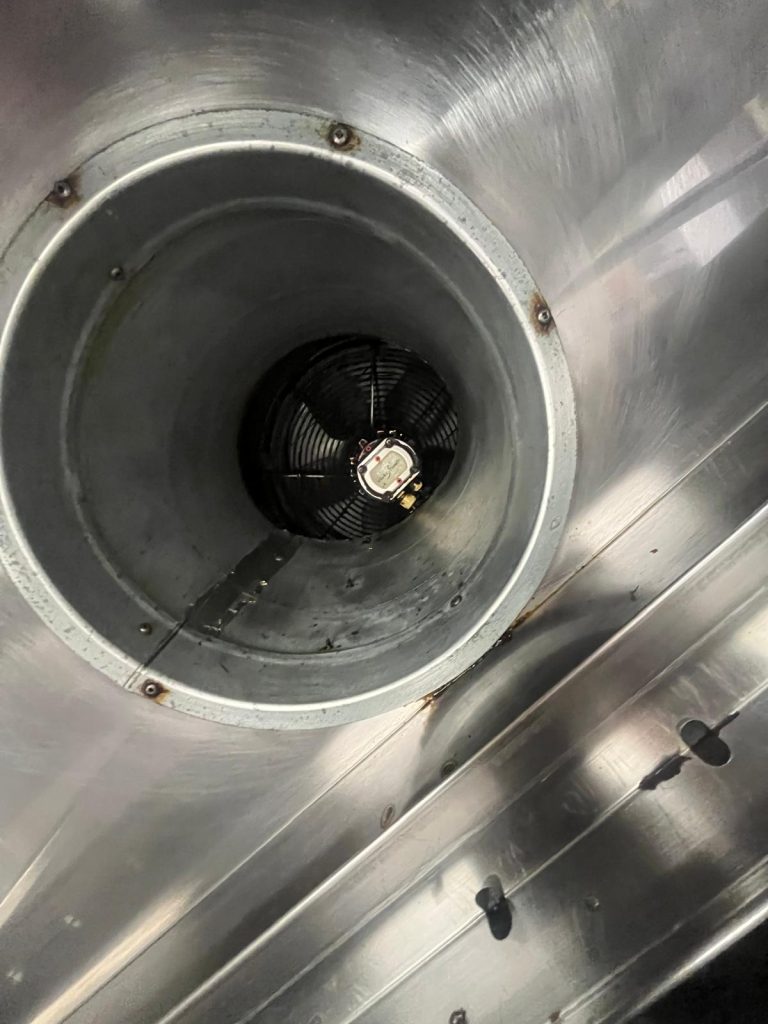
Historic EC Cleaners technical archive image. It illustrates why internal evidence should be attributable to a recognisable system location; it is not presented as a current technical measurement or as evidence of any specific micron value.
How micron readings should influence the next cleaning date
Deposit measurements can help show whether the current maintenance interval is controlling grease accumulation effectively. They should be reviewed alongside operating hours, cooking process, previous condition, access, photographs, fire-risk findings and relevant insurer requirements.
A reading therefore becomes more useful when it contributes to a trend: what was measured previously, where it was measured, how long the system had been operating and whether the same areas are accumulating grease faster than expected.
What EC can – and cannot – do with a report containing micron readings
EC can organise
The supplied report, measurement table, photographs, certificate, exclusions, recommendations and associated commercial documents.
EC can identify
Where readings appear, what system or location they appear to relate to, what information is missing and what questions should be taken back to the contractor or adviser.
EC cannot validate
The measurement method, technical accuracy of a reading, physical system cleanliness, fire safety or compliance conclusion.
EC can route
A clearer follow-on requirement where the report identifies further cleaning, access, remediation, inspection or another specialist need.
Continue the cleaning-frequency cluster
Micron readings are one part of the evidence used to understand condition and maintenance frequency. The parent scheduling page explains the wider regime, while the previous supporting page explains the practical signs that may indicate the system needs attention.
TR19 grease micron readings: frequently asked questions
What does a 200-micron grease reading mean in TR19 Grease?
BESA’s current public guidance says grease levels should be controlled so that the mean average does not exceed 200 microns between scheduled cleans. A reading should therefore be interpreted in the context of where it was taken, the other readings in the system, the system scope and any inaccessible areas.
Does one reading below 200 microns prove the whole kitchen extract system is clean?
No. A single result only describes the location that was measured. TR19-related cleanliness evidence should be considered across representative sections of the extraction system together with photographs, scope, exclusions and access information.
What happens if a local area measures 500 microns or more?
BESA’s January 2026 public guidance says areas showing grease deposits of 500 microns or more require immediate spot-cleaning attention. The wider system condition and cleaning regime should still be considered rather than treating the local reading in isolation.
What is a Deposit Thickness Test?
A Deposit Thickness Test, commonly shortened to DTT, is used to measure the thickness of deposits on internal duct surfaces. BESA describes it as a way of obtaining objective, measurable evidence of contamination at representative points within the system.
What is a Wet Film Thickness Test?
BESA’s current kitchen-extract guidance refers to Wet Film Thickness Testing, or WFTT, alongside DTT as a method used to measure grease deposits at points within kitchen extract ductwork.
Should a post-clean report include micron readings?
BESA’s current public guidance says post-clean verification reporting should include DTT or WFTT measurements, together with before-and-after photographs, a written summary of work, access limitations or areas requiring attention, system information and the hygiene certificate.
Can EC Cleaners Network validate a contractor’s micron readings?
No. EC can help organise the customer-supplied report, identify where readings appear in the evidence and compare them with the stated scope and exclusions, but technical measurement, validation and compliance conclusions remain with the competent contractor or professional.
Have a TR19 report with micron readings you need to understand?
Send the report and the commercial question you are trying to resolve. EC can help organise the supplied measurements, system scope, exclusions and recommendations so the next contractor or professional discussion starts from the actual evidence.
Responsibility statement:
EC Cleaners Network is operated by Search and Submit Ltd. Search and Submit Ltd does not inspect, clean, test, survey, design, remediate, certify or technically approve kitchen extraction or ventilation systems. Independent appointed contractors and competent professionals remain responsible for technical assessment, safe working, quotations, physical delivery, reporting, certification and professional conclusions within their appointed scope.
TR19® Grease and TR19® Air are BESA specifications. References are descriptive and no BESA endorsement of or affiliation with EC Cleaners Network is claimed.