
EC Cleaners Network · Kitchen Extract Questions
The next cleaning date should come from the kitchen’s operating conditions and the evidence found in the system, not simply from repeating the last interval.
BESA publishes baseline frequency bands linked to daily operating hours, but its current guidance also says the actual interval should be reviewed against cooking type, seasonal menu changes, grease accumulation rate, system condition and deposit thickness test results.
Do you need to review the next cleaning date?
Send the current interval, last report, site details and any change in cooking hours, menu, equipment, access or operating pattern. If an insurer, fire risk assessor or other adviser has specified a requirement, include that information as well.
Search and Submit Ltd uses your details to respond and coordinate the enquiry, including sharing relevant information with appropriate independent specialists. Read our Privacy Policy. Please omit unrelated personal or sensitive information.
How should the next commercial kitchen extract cleaning date be decided?
The starting point is the kitchen’s operating pattern, but the final recommendation should reflect the evidence available at the time of inspection or cleaning.
BESA’s current guidance gives baseline frequencies of three months for heavy use, six months for moderate use and twelve months for lighter use. It also says these are minimum recommendations and that actual frequency should be determined by a competent person using the kitchen’s cooking type, seasonal menu variation, grease accumulation rate and deposit thickness testing.
The date should be explainable. A facilities team should be able to see why the interval was chosen and what evidence would cause it to change.
Read the full kitchen extract cleaning-frequency and scheduling guide →
Seven things that should influence the next cleaning date
1. Daily operating hours
BESA uses daily operating hours as the baseline for its published cleaning-frequency bands. They are a useful starting point, but they are not the whole decision.
2. Cooking type
Different cooking processes can create very different grease loads. A kitchen producing large amounts of grease may need a different interval from another kitchen operating for similar hours.
3. Cooking volume and menu changes
A busier service, increased covers, changed menu or new equipment can alter grease production. BESA specifically identifies seasonal menu variation as a factor that can affect cleaning frequency.
4. Inspection findings
The observed condition of the canopy, plenum, ductwork, fan and other accessible parts of the system should influence whether the previous interval remains suitable.
5. Deposit measurements
Representative micron readings can help show whether grease is accumulating faster or slower than expected. Trends are more useful when the measurement locations and operating period are clear.
6. Access limitations
If parts of the system could not be inspected or cleaned, the condition of those sections remains uncertain. The next date should not make that uncertainty disappear.
7. Fire risk, insurance and professional requirements
An insurer, fire risk assessment or other professional recommendation may require a different maintenance regime. The original trigger should remain visible when the contractor makes a recommendation.
Why the last cleaning interval should not be copied forward automatically
A previous interval may have been sensible when it was first set, but kitchens change. Trading hours can increase, the menu can become more grease intensive, equipment can change and the extract system can show a different accumulation pattern at the next inspection.
Copying the old date forward without looking at the new evidence risks turning a maintenance recommendation into an administrative habit.
For portfolio teams, consistency should mean a consistent decision process, not the same interval at every site.
How deposit measurements can help
Representative deposit thickness readings give the contractor objective evidence from measured locations inside the system. BESA’s current public guidance says grease levels should be controlled so that the mean average does not exceed 200 microns between scheduled cleans.
For maintenance planning, the value is in the relationship between the reading, its location, the length of time since the previous clean and the operating conditions during that period.
One reading should not be used as a shortcut for understanding the whole system, particularly where other sections were inaccessible.
What should happen after the clean?
The cleaning report should give the client enough information to understand what was completed and what remains outstanding. BESA’s current public guidance describes post-clean verification that includes photographs, DTT or WFTT measurements, a written summary of completed work, access limitations or other areas requiring attention, cleaned-area information and a hygiene certificate.
The next recommended date is more useful when it sits alongside this evidence rather than appearing as an isolated line on a certificate.
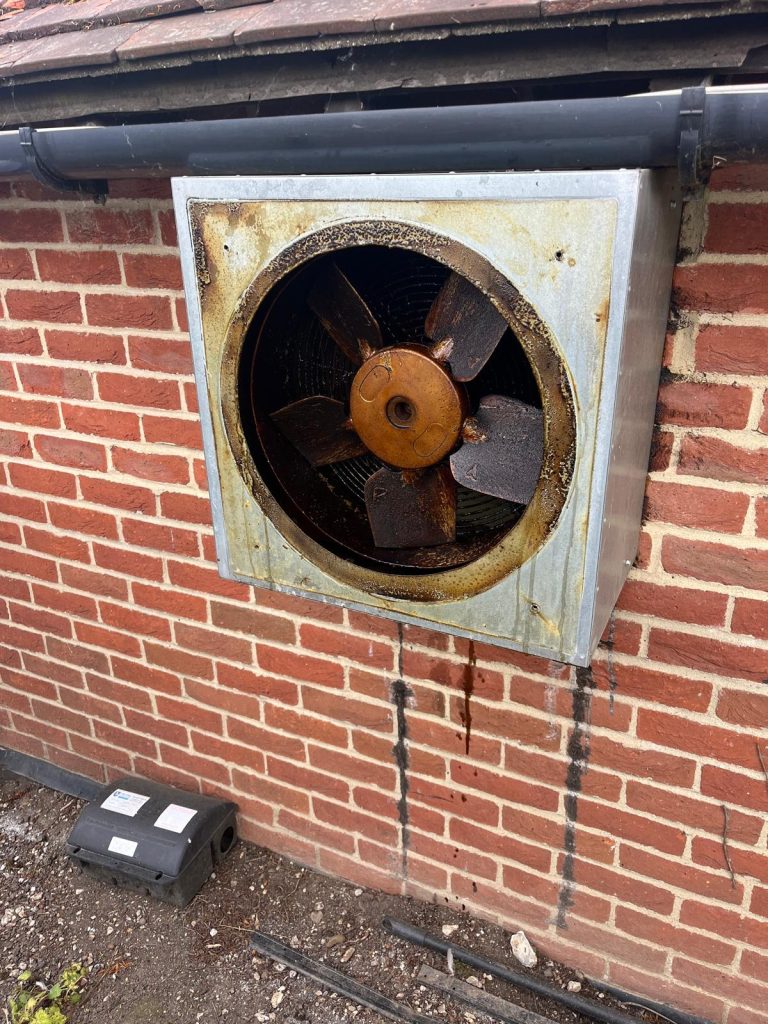
Historic EC Cleaners project imagery illustrates the wider extraction system. It is not presented as a current condition assessment or as evidence for any particular cleaning interval.
A practical way to review the next cleaning date
- Confirm the last clean and inspection dates. Establish the actual maintenance history before setting the next date.
- Review how the kitchen has operated. Check hours, cooking type, volume, equipment and menu changes.
- Review the condition evidence. Use photographs, observations and representative deposit measurements where available.
- Check the system scope. Confirm which parts were inspected and cleaned.
- Keep access problems visible. Do not allow inaccessible areas to vanish from the maintenance decision.
- Consider external requirements. Retain relevant fire risk, insurer or professional recommendations.
- Record the recommendation and reason. The next date should be accompanied by enough context for the client to understand why it was selected.
What should a facilities or estates team record?
Current interval
The inspection and cleaning frequency currently being used for the system.
Reason for the interval
The operating hours, cooking activity and technical evidence supporting the recommendation.
Last findings
Relevant observations, photographs, deposit measurements and recommendations from the latest report.
Known limitations
Inaccessible, excluded or incomplete sections that still affect confidence in the whole-system picture.
Operational changes
Material changes in trading hours, production, menu or equipment since the interval was last reviewed.
Next review trigger
The date or event that should prompt the maintenance interval to be reviewed again.
What if the kitchen changes before the next scheduled clean?
The published date should not prevent an earlier review when the kitchen changes materially or new evidence becomes available. A change in cooking volume, menu, equipment, system performance, fire risk findings or insurer requirements can justify looking at the maintenance regime before the planned date arrives.
Likewise, if a report identifies an access problem or another unresolved action, waiting for the next routine cleaning date may not be the correct response. The action should be managed according to what was found.
Continue the cleaning-frequency cluster
This page explains how the next date should be reviewed. The related pages cover the overall scheduling regime, signs that the system may need attention, deposit measurements, inspection and the factors that change grease accumulation.
Next kitchen extract cleaning date: frequently asked questions
Who decides the next commercial kitchen extract cleaning date?
The next date should be recommended by the competent contractor or professional responsible for the inspection, cleaning or technical assessment within their appointed scope. The recommendation should take account of the kitchen’s operating profile, cooking type, system condition, grease accumulation, deposit measurements, access and relevant fire risk or insurance requirements.
Can I simply add three, six or twelve months to the last cleaning date?
Not automatically. BESA publishes baseline frequency bands linked to operating hours, but its current guidance also says actual frequency should be reviewed against cooking type, seasonal menu variation, grease accumulation rate and deposit thickness test results.
What if the kitchen has become busier since the last clean?
A material increase in cooking hours, production volume, menu intensity or grease-producing activity is a reason to review the existing interval. The new operating profile should be considered alongside the inspection evidence.
Should micron readings affect the next cleaning date?
Yes, where representative deposit measurements are available they can help show whether the existing interval is controlling grease accumulation effectively. They should be read alongside the wider inspection findings rather than treated as a single standalone answer.
What if part of the ductwork was inaccessible?
The access limitation should remain visible. A return date based only on accessible areas does not establish the condition of an inaccessible section. Additional access or further assessment may be required.
Can an insurer or fire risk assessor require a different interval?
A fire risk assessment, insurer requirement or other professional recommendation can affect the maintenance regime. The original requirement should be retained so that the contractor’s scope and evidence address the reason the action was raised.
Should the next cleaning date appear on the report?
The report should make the contractor’s recommendation and its basis clear enough for the client to manage the maintenance programme. A date without supporting context is less useful than a recommendation linked to operating conditions, findings and any remaining limitations.
Need to review the next cleaning date?
Send the latest report, current interval and any change in the way the kitchen is operating. EC can help organise the information so the next contractor or professional discussion starts from the current evidence rather than an inherited date.
Responsibility statement:
EC Cleaners Network is operated by Search and Submit Ltd. Search and Submit Ltd does not inspect, clean, test, survey, design, remediate, certify or technically approve kitchen extraction or ventilation systems. Independent appointed contractors and competent professionals remain responsible for technical assessment, safe working, quotations, physical delivery, reporting, certification and professional conclusions within their appointed scope.
TR19® Grease and TR19® Air are BESA specifications. References are descriptive and no BESA endorsement of or affiliation with EC Cleaners Network is claimed.