
EC Cleaners Network · Kitchen Extract Questions
A commercial kitchen extract may need attention before grease becomes obvious from the kitchen floor.
Useful warning signs include overdue maintenance, visible contamination, previous report findings, a shorter recommended return interval, changed cooking activity or unresolved access. But no single visible sign can tell you the condition of the complete extract route.
Tell us what makes you think the system may be due
Send the site location, the last known inspection or cleaning date and what you have noticed. If you already have a report, certificate, photographs, quotation, fire-risk action or insurer correspondence, include that information where possible.
Search and Submit Ltd uses your details to respond and coordinate the enquiry, including sharing relevant information with appropriate independent specialists. Read our Privacy Policy. Please omit unrelated personal or sensitive information.
How do I know if my commercial kitchen extract needs cleaning?
The most useful answer comes from several pieces of evidence rather than one visual clue. A system may need inspection or cleaning because the planned maintenance date has passed, grease is visible on accessible components, a previous report records significant accumulation, the cooking load has increased, or an earlier inspection recommends a shorter return interval.
BESA explains that commercial kitchen extract systems continuously draw grease, oil vapours and airborne particulates through the ventilation route and that cleaning frequency should be reviewed according to usage, cooking type, system condition, grease accumulation and risk findings.
Do not wait for the canopy to look dirty before asking the question. The visible hood is only one part of a system that may continue through plenums, ductwork, risers, fans and discharge sections.
Read the full kitchen extract cleaning-frequency and scheduling guide →
Seven signs that the system deserves review
1. The planned cleaning date has passed
If the system is beyond its established maintenance interval, review the previous report and operating conditions rather than allowing the date to drift without a recorded reason.
2. Grease is visible on accessible components
Grease around the canopy, plenum, filters or accessible ductwork is a useful warning sign, but it should not be treated as a complete assessment of internal sections that cannot be seen.
3. A previous report records significant deposits
Photographs, observations and deposit-thickness measurements can provide stronger evidence than appearance alone and may support a different cleaning or inspection interval.
4. The previous report recommends an earlier return
A report may recommend action sooner because of the grease-loading rate, inaccessible sections, incomplete work or another finding. Read the recommendation rather than copying only the certificate date.
5. Cooking activity has changed
Longer opening hours, higher throughput, new equipment or more grease-producing cooking can change how quickly contamination accumulates even if the previous schedule once appeared suitable.
6. Grease-related odours or contamination are recurring
Persistent grease contamination or odours can justify investigation, but they are symptoms rather than proof of the exact location or extent of internal deposits.
7. Known areas were inaccessible last time
If parts of the duct route or fan could not be reached, the last visit may not describe the condition of the entire system. The access problem should stay visible until it is properly addressed.
What you can see does not tell you everything
The most accessible parts of the extraction system are not necessarily the parts carrying the greatest hidden accumulation. A clean-looking canopy does not prove that internal ductwork, risers, bends, fans or discharge sections are equally clean.
The same principle works in reverse: grease visible on a filter or canopy tells you the system deserves attention, but it does not by itself establish the condition of every internal section or the technical scope of the required work.
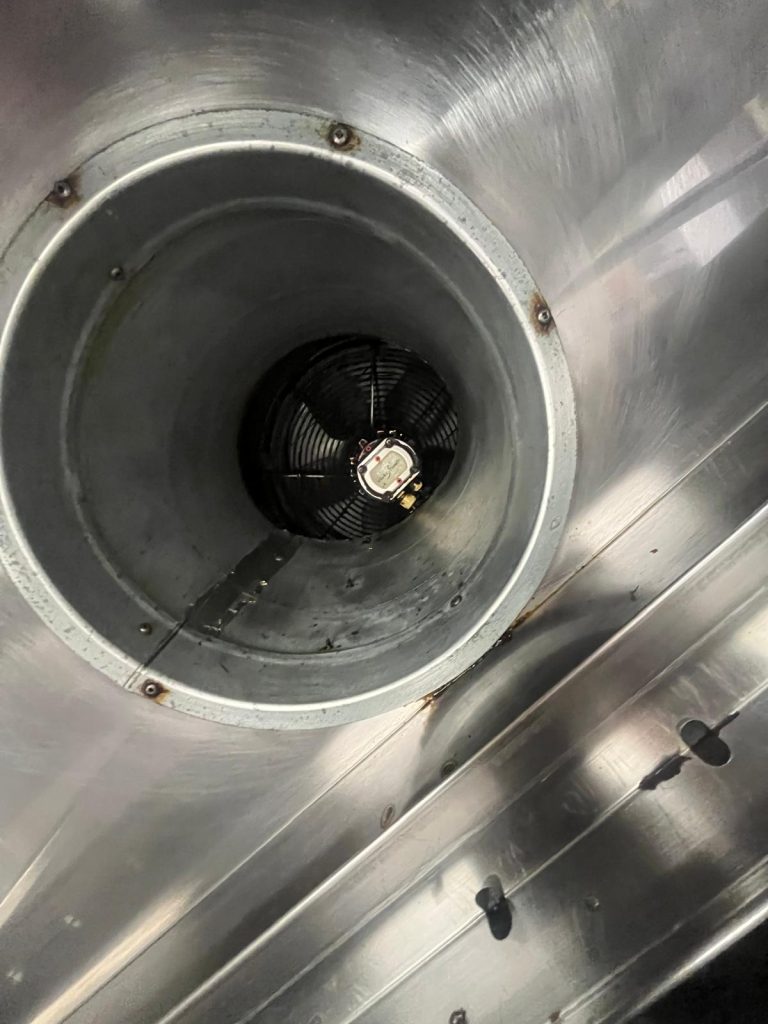
Historic EC Cleaners project imagery is used to illustrate internal kitchen-extract context. It is not presented as a technical finding about the property making an enquiry.
What does a previous report tell you?
A useful previous report can tell you much more than the date on a certificate. Before deciding whether another clean is due, look for the following:
- System identity. Which kitchen, canopy and extract route was actually inspected or cleaned?
- Scope. Were canopy, plenum, ductwork, risers, fan and discharge sections included?
- Condition findings. What contamination, grease accumulation or other concerns were recorded?
- Deposit measurements. Where measurements were taken, what do they show about internal accumulation and the suitability of the interval?
- Access limitations. Were any sections inaccessible, excluded or not completed?
- Recommendations. Was remedial work, additional access or an earlier return date recommended?
- Evidence quality. Can the photographs and observations actually be related to identifiable parts of the system?
Poor extraction is not automatically a cleaning diagnosis
Smoke escaping the canopy, reduced capture, excessive heat, unusual fan noise or persistent odours may occur at the same time as contamination, but they can also involve airflow, make-up air, fan condition, controls, system balance, blockage, access, design or another mechanical or ventilation issue.
If the primary problem is performance rather than maintenance timing, treat that as a different question rather than instructing a cleaning-only scope by assumption.
Commercial kitchen extraction not working properly – what should you check? →
Why grease accumulation matters
TR19® Grease is specifically focused on fire-risk management of grease accumulation within commercial kitchen extraction systems. BESA notes that grease and oil residues accumulate on internal surfaces and can create a serious fire hazard if they are not properly controlled.
London Fire Brigade advises restaurants and takeaways to have kitchen ducting cleaned regularly to avoid grease build-up. In May 2026, the Brigade reported a Lee Green restaurant fire that it believed had been caused by a build-up of grease in the ducting.
The lesson is not that every dirty-looking component creates the same level of risk. It is that hidden grease accumulation should be managed through a suitable inspection, cleaning and evidence regime rather than waiting for a visible problem to become severe.
If you think the system is due, what should you send with the enquiry?
You do not need to diagnose the whole system before contacting EC. Preserve the information that will help an appropriate contractor understand why the system is being reviewed.
- Site and kitchen. Identify the property and the kitchen or extraction system involved.
- Last known clean or inspection. Include the date and report where available.
- Operating profile. Note typical hours, cooking type and any recent change in use.
- What you have noticed. Visible grease, odours, recurring contamination or other relevant observations.
- Existing evidence. Reports, certificates, photographs, quotations, insurer correspondence or fire-risk actions.
- Known access issues. Record inaccessible ductwork, roof restrictions, fan access or previous exclusions.
Continue the cleaning-frequency guidance
This page answers the question “what tells me the system may need attention now?” The parent scheduling guide explains how the ongoing interval should be set and reviewed.
Frequently asked questions
What are the clearest signs that a commercial kitchen extract may need cleaning?
Useful warning signs include an overdue maintenance date, visible grease on accessible parts of the system, previous reports showing significant grease accumulation, a recommendation for an earlier return visit, recurring odours associated with grease contamination, or a change in cooking activity that increases grease production. These signs indicate the need for review; they do not by themselves prove the condition of the complete extract route.
Can I tell from the canopy whether the whole extract system is dirty?
No. The canopy is only one part of the extraction route. Grease can accumulate in plenums, ductwork, risers, fans and discharge sections that cannot be judged from the visible kitchen area.
Does poor airflow mean the kitchen extract needs cleaning?
Not necessarily. Contamination can contribute to performance problems, but weak capture or airflow can also involve fan condition, make-up air, controls, system balance, blockage, design or other mechanical and ventilation issues. A performance problem should be investigated rather than automatically treated as a cleaning-only issue.
What does a previous TR19 report tell me about whether cleaning is due?
A useful report can show the system inspected, condition findings, deposit measurements where taken, inaccessible sections, completed work, exclusions, recommendations and the proposed next review or cleaning interval. The detailed report is usually more informative than the certificate date alone.
What if the last clean left part of the ductwork inaccessible?
The inaccessible section should remain visible in the current requirement. Repeating a cleaning visit does not itself solve an access problem; the system may need additional access provision or other enabling work before the affected section can be properly inspected or cleaned.
Should I wait for visible grease before arranging an inspection or clean?
No. A maintenance regime should not depend only on grease becoming visible in the kitchen. Cleaning frequency should be reviewed against operating hours, cooking type, previous condition, deposit accumulation, fire-risk findings, access and relevant insurer requirements.
Not sure whether the kitchen extract system is due?
Send the site location, previous cleaning or inspection date and any report, certificate, photographs or other evidence already available. The starting point is the information you have – not an assumed contractor scope.
Responsibility statement:
EC Cleaners Network is operated by Search and Submit Ltd. Search and Submit Ltd does not inspect, clean, test, survey, design, remediate, certify or technically approve kitchen extraction or ventilation systems. Independent appointed contractors and competent professionals remain responsible for technical assessment, safe working, quotations, physical delivery, reporting, certification and professional conclusions within their appointed scope.
TR19® Grease and TR19® Air are BESA specifications. References are descriptive and no BESA endorsement of or affiliation with EC Cleaners Network is claimed.