
EC Cleaners Network · Kitchen Extract Problems
Grease leaking or dripping from kitchen extract ductwork should not be treated as a surface cleaning problem.
Visible grease escaping from the system can point to significant internal contamination, a local containment issue, a joint or access-point problem, or a section of the extract route that has not been effectively maintained. The source and wider system condition need to be understood before the work is scoped.
Where is the grease escaping from the system?
Send the site location, photographs where safe to obtain, the latest cleaning or inspection report and the last known cleaning date. Include any previous access limitation, incomplete clean or recurring problem already recorded.
What can grease leaking from kitchen extract ductwork indicate?
Visible grease outside the normal contained extract route is a sign that the system deserves prompt investigation. It does not identify one single cause, but it can indicate that grease has accumulated internally and is escaping at a local weak point or around an access feature, joint, fan or other section.
BESA states that commercial kitchen extract systems continuously draw grease, oil vapours and airborne particulates through the ductwork. These deposits accumulate on internal surfaces and can become a serious fire hazard if they are not properly controlled.
The visible drip is the symptom. The source may be elsewhere in the extract route.
Read the parent guide to commercial kitchen extraction problems →
Possible reasons grease may appear outside the ductwork
Heavy internal contamination
A substantial grease load inside the extract route can create visible leakage at local points, particularly where deposits have been allowed to accumulate for an extended period.
A joint or local containment problem
Grease may become visible around a duct joint, seam, access panel, connection or other local feature. The contractor should establish the source rather than cleaning only the outside surface.
Incomplete previous cleaning
If part of the extract route was excluded, inaccessible or not completed, contamination may remain in sections that continue to affect the system.
Inaccessible ductwork
Known inaccessible sections can allow contamination to remain unverified and unresolved between cleaning visits.
Fan or discharge contamination
Grease can accumulate throughout the extraction route, including fans and discharge points. The leak location should therefore be considered in relation to the whole system.
Changed cooking load
Higher production, longer hours or more grease-intensive cooking can increase the rate of accumulation and expose weaknesses in an existing maintenance regime.
Why wiping away the visible grease is not enough
Cleaning the outside of a duct or ceiling area may remove the immediate contamination, but it does not establish where the grease came from or how much remains inside the system.
The investigation should identify the affected extract route, the last cleaning scope, any areas that could not be reached and whether the leak is linked to heavy contamination, a local containment problem or another maintenance issue.
Why grease accumulation needs prompt attention
BESA’s current kitchen extract guidance says grease residues are highly flammable and can allow fire to spread through ductwork and into other parts of a building. HSE also warns that fat residues and blocked air inlets can reduce ventilation efficiency and increase fire risk.
London Fire Brigade continues to report commercial kitchen fires caused by grease build-up in extraction systems. In May 2026, the Brigade said a restaurant fire in Lee Green was believed to have been caused by grease accumulation in the ducting.
Visible leakage does not prove the same fire condition exists at another site, but it is a strong reason not to ignore the internal condition of the extract system.
Check the whole extract route
Grease contamination is not limited to the canopy. Depending on the installation, the relevant route can include filters, canopy, plenum, ductwork, risers, fan, discharge and the access needed to inspect and clean those parts.
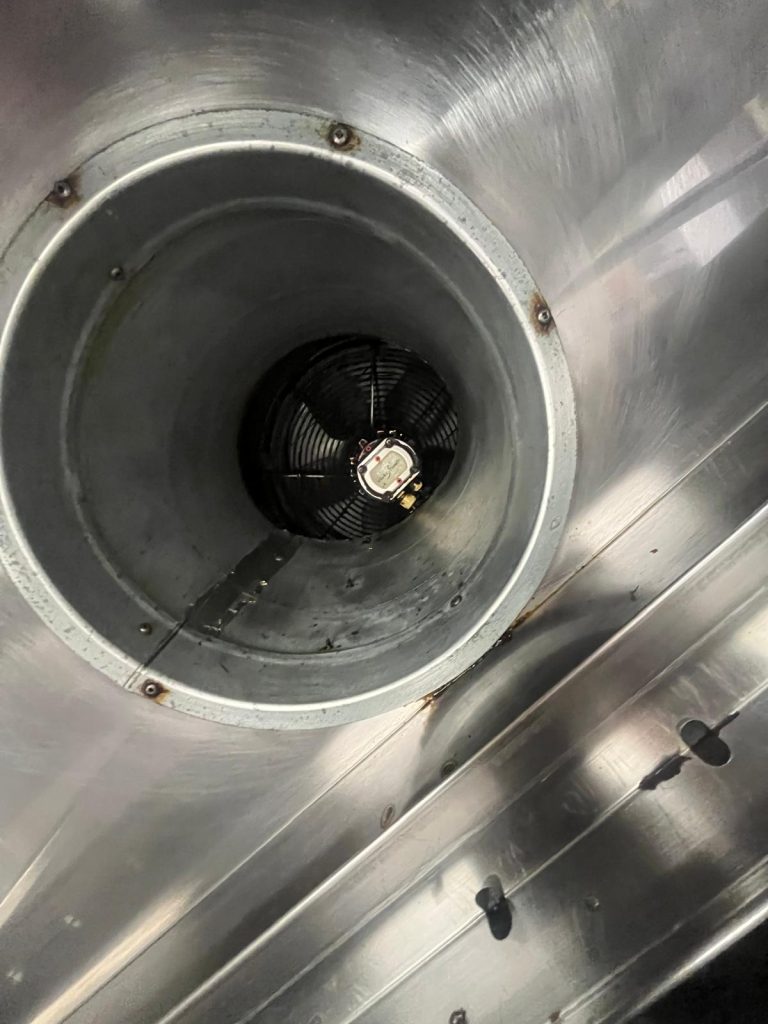
Historic EC Cleaners project imagery illustrates internal kitchen extract ductwork. It is not presented as evidence of leakage or contamination at the photographed premises.
What if the leak is near electrical equipment, ceilings or hot surfaces?
Do not attempt unsafe access or improvised cleaning around live electrical equipment, hot cooking equipment, roofs, high-level ductwork or enclosed spaces.
Where grease is escaping into a ceiling void, around electrical equipment, near hot surfaces or into an occupied area, obtain competent site-specific advice promptly and manage the immediate safety risk according to the circumstances of the premises.
The priority is to control the immediate risk and establish the source, not to make the visible area look clean.
What should you check in the previous cleaning report?
- System identity. Confirm which kitchen and extract route the report covered.
- Cleaning scope. Check whether canopy, plenum, ductwork, fan and discharge were included.
- Access limitations. Look for inaccessible sections, exclusions or areas that could not be completed.
- Photographs. Check whether the evidence can be linked to identifiable parts of the system.
- Deposit readings. Review any representative measurements that were recorded before or after cleaning.
- Outstanding actions. Check for access work, additional cleaning, repairs or other follow-up recommendations.
- Recommended return date. Confirm whether the current cleaning interval was based on the actual condition found.
Which contractor route may be appropriate?
Heavy grease contamination
Where the system is heavily contaminated, a competent kitchen extract cleaning contractor may be needed to inspect and clean the relevant accessible route.
Access limitation
If the affected ductwork cannot be reached, additional access panels, high-level access or another enabling measure may be required.
Local duct or joint issue
Where the visible leak appears to involve a local duct connection, joint, access panel or containment problem, a competent contractor should assess the physical issue.
Unclear previous clean
If earlier reports do not show what was actually cleaned, excluded or left inaccessible, organise the evidence before issuing another instruction.
Recurring maintenance problem
If leakage returns after previous cleaning, review the cleaning interval, operating pattern, access and the evidence from the last visit.
Contractor selection
Once the workstream is understood, check that the contractor has the competence, insurance and access capability for the actual job.
What should you record before the leak is investigated?
- Exact location. Record where the grease is appearing and what part of the extract route is nearby.
- Photographs. Take clear images where this can be done safely.
- When it was first noticed. Note whether the leak is new, intermittent or recurring.
- Last cleaning date. Find the latest cleaning and inspection records.
- Known access issues. Keep previous inaccessible sections visible.
- Recent kitchen changes. Record any increase in operating hours, production or grease-intensive cooking.
- Immediate hazards. Note proximity to electrical equipment, hot surfaces, ceilings, occupied areas or other sensitive locations.
Related kitchen extract problem guidance
This page focuses on visible grease leakage. The related pages cover weak fan pull, smoke spillage, persistent odour and the wider range of kitchen extraction problems.
Grease leaking from kitchen extract ductwork: frequently asked questions
Why is grease leaking or dripping from commercial kitchen extract ductwork?
Visible grease escaping from ductwork can indicate significant internal contamination, a local containment issue, a problem around a joint or access point, or a section of the system that has not been effectively maintained. The exact cause needs to be established by a competent contractor.
Does dripping grease mean the whole extract system needs cleaning?
Not automatically, but it is a strong reason to review the wider system. The leak may be local while the contamination is more widespread, so the inspection should establish the system scope, condition of accessible sections and any areas that remain inaccessible.
Is grease leaking from ductwork a fire risk?
Grease accumulation in kitchen extract systems is a recognised fire hazard. BESA states that grease and oil residues can ignite and allow fire to spread through ductwork, while London Fire Brigade continues to report restaurant fires caused by grease build-up in extraction systems.
Should I just clean the area where the grease is dripping?
No. Cleaning the visible surface may remove the immediate mess but does not establish where the grease originated or the condition of the internal extract route. The source and wider system should be assessed.
Can inaccessible ductwork contribute to repeated grease leakage?
It can. If sections cannot be reached for inspection or cleaning, contamination in those areas may remain unresolved. The access limitation should stay visible until the affected section can be properly assessed.
What should I do if grease is dripping near electrical equipment or hot cooking areas?
Treat the situation as a priority and obtain competent site-specific advice. Do not attempt unsafe access or improvised cleaning around live electrical equipment, hot surfaces or inaccessible ductwork.
What information should I send when reporting a grease leak?
Send the site location, photographs of the affected area where safe to obtain, the latest cleaning or inspection report, the last known cleaning date, any previous access limitations and details of where the leak appears in relation to the duct, fan, canopy or ceiling.
Is grease leaking or dripping from the kitchen extract system?
Send the site details, photographs, latest report and last known cleaning date. EC can help organise the requirement so contamination, access, containment and maintenance issues are separated before the appropriate independent specialist is approached.
Responsibility statement:
EC Cleaners Network is operated by Search and Submit Ltd. Search and Submit Ltd does not inspect, clean, test, survey, design, remediate, certify or technically approve kitchen extraction or ventilation systems. Independent appointed contractors and competent professionals remain responsible for technical assessment, safe working, quotations, physical delivery, reporting, certification and professional conclusions within their appointed scope.
TR19® Grease and TR19® Air are BESA specifications. References are descriptive and no BESA endorsement of or affiliation with EC Cleaners Network is claimed.