
EC Cleaners Network · From Requirement to Evidence
If Environmental Health or another local authority team has raised an issue with the kitchen extraction, work from the exact written action rather than assuming the answer is simply to order a TR19 clean.
The council involvement may relate to food hygiene, the physical condition of the premises, grease contamination, poor ventilation, odour, noise, planning conditions or another specific issue. The contractor scope should respond to what has actually been identified and the evidence the council expects afterwards.
What has the council actually asked you to do?
Send the inspection letter, improvement action, notice, email or other written requirement if available. Include the site location, any completion date and the latest kitchen extract cleaning or ventilation report.
Search and Submit Ltd uses your details to respond and coordinate the enquiry, including sharing relevant information with appropriate independent specialists. Read our Privacy Policy. Please omit unrelated personal or sensitive information.
First identify why the local authority is involved
A local authority can become involved with a commercial kitchen through different functions. GOV.UK says council food inspectors can check the physical condition of a food business, including cleanliness, layout and ventilation. Separate environmental protection teams can investigate complaints about commercial smells and other potential statutory nuisances.
Those routes can produce very different requirements. A food hygiene action about cleanliness should not automatically be treated as the same job as an odour complaint, a ventilation-performance problem or a formal statutory nuisance notice.
Keep the council’s wording intact. The trigger determines the scope.
What type of action have you received?
Food hygiene inspection action
The officer may have identified cleanliness, maintenance, ventilation or another physical condition that needs improvement. Use the exact inspection wording to define the response.
Grease or extract-cleaning action
If the issue specifically concerns grease contamination in the extraction system, specialist kitchen extract inspection or cleaning may be appropriate.
Odour complaint
The problem may involve capture, airflow, discharge location, odour control, contamination or the cooking process rather than cleaning alone.
Noise complaint
Fan noise, vibration, duct transmission or plant operation can require mechanical or acoustic investigation rather than hygiene work.
Planning or premises condition
The council may be considering the suitability or operation of the extraction system against planning conditions or the way the premises is being used.
Formal notice or enforcement action
Preserve the document, deadline and response route. Technical contractor work should be organised around the actual notice rather than a verbal summary.
If the issue came from a food hygiene inspection
GOV.UK says local council food inspectors can check how hygienically food is handled, the physical condition of the business and the systems used to maintain good hygiene. The physical-condition check includes cleanliness, layout, lighting, ventilation, pest control and other facilities.
After inspection, a business can be told what improvements are needed and by when. For serious food-safety problems, formal notices may also be used.
If kitchen extraction is mentioned, read the wording carefully. It may be asking for cleaning, repair, maintenance, improved ventilation or another action. TR19 Grease is relevant to grease accumulation within kitchen extraction systems, but it should not be inserted into the instruction unless it fits the actual technical requirement.
If the issue is odour or nuisance
In England, GOV.UK says councils must investigate complaints about smells from industrial, trade and business premises that could amount to a statutory nuisance. Commercial kitchens with poor extraction are specifically listed as a possible source of nuisance smells.
A council can consider the source of the smell, the character of the area, the number of people affected, how often and how long the smell occurs, its strength and character, and weather conditions.
This means a neighbour complaint should not automatically become a duct-cleaning instruction. The technical investigation may need to consider capture, extract performance, contamination, discharge position, odour control and cooking activity.
Cleaning may be part of an odour solution, but it is not a substitute for establishing how and where the odour is escaping.
What if you have received a formal notice?
Do not paraphrase a formal notice into a shorter contractor request. Keep the document intact, record the compliance date and follow any appeal, response or evidence instructions included in it.
In England, GOV.UK explains that councils must serve an abatement notice if they are satisfied that a statutory nuisance exists, has occurred or is likely to occur. Other formal notices can arise through food-safety enforcement. The legal route and available response depend on the actual notice.
EC can help organise the technical information and contractor requirement. EC does not interpret formal notices, give legal advice or determine whether an enforcement action should be challenged.
Turn the action into a physical system scope
If specialist extract cleaning is required, establish which kitchen and extraction route are affected. The relevant system can include filters, canopy, plenum, horizontal and vertical ductwork, risers, fan and discharge.
BESA describes TR19® Grease as the specification for managing fire risk from grease accumulation within commercial kitchen extraction systems and for industry best practice in inspection and cleaning. It applies to the physical extract system, not simply to the issue of a certificate.
Check access before the work is booked
A contractor cannot inspect or clean a section properly if it cannot be reached. Previous reports may already identify inaccessible ductwork, missing access panels, roof restrictions or sections hidden above ceilings.
If the council action concerns the condition of the wider extract system, those access limitations should be visible in the contractor enquiry before the job is priced. Cleaning only the reachable sections may not respond to the original requirement.
What should the contractor quotation make clear?
- The system being addressed. Identify the kitchen and extract route.
- The included components. State canopy, plenum, ductwork, fan, discharge and other included sections.
- Access assumptions. Identify roof access, panels, high-level work and any enabling requirements.
- Known exclusions. Keep inaccessible or out-of-scope areas visible.
- Required evidence. State the report, photographs, measurements or certificate expected afterwards.
- Completion timing. Reflect any genuine council deadline supplied in the original action.
What evidence should come back after the work?
The evidence package should respond to the original council action. BESA’s current public guidance describes post-clean verification including before-and-after photographs from matching positions, DTT or WFTT measurements, a written summary of work completed, access limitations or areas needing attention, cleaned-area information and a hygiene certificate.
Do not let unresolved exclusions disappear behind the certificate. If part of the system could not be cleaned, if a mechanical issue remains, or if the odour problem still needs investigation, keep that action visible.
Historic project context
A local authority action that refers to kitchen extraction can involve equipment and ductwork that extend beyond the visible canopy. The contractor scope and evidence should therefore relate to identifiable parts of the actual system.
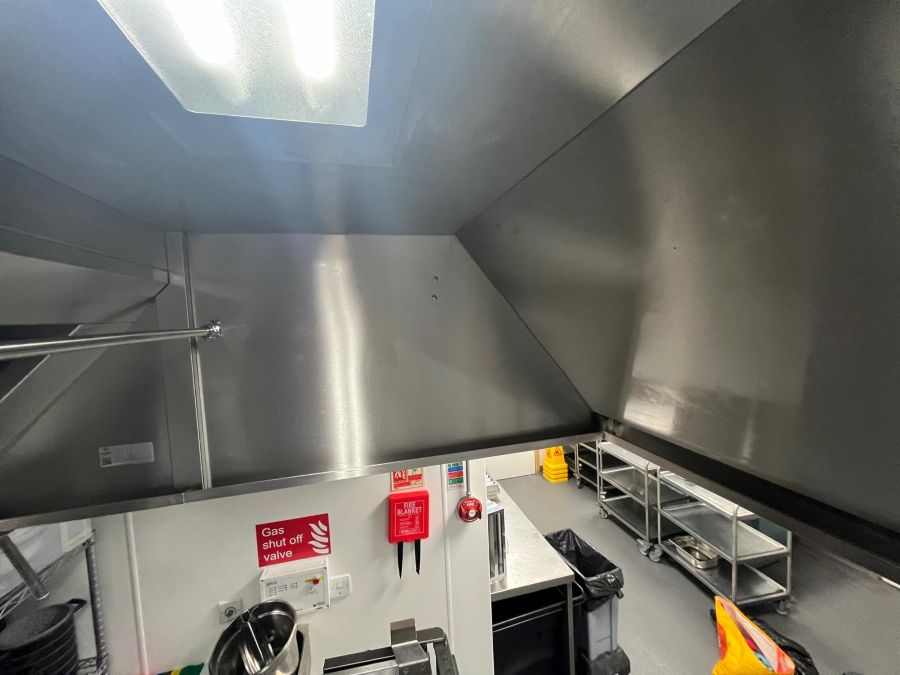
Historic EC Cleaners project imagery illustrates a commercial kitchen extraction environment. It is not presented as evidence of an Environmental Health or local-authority action at the photographed premises.
A practical council-action workflow
- Keep the original document. Preserve the exact finding, required action, deadline and officer or council team.
- Identify the route. Establish whether the issue concerns food hygiene, extraction cleanliness, ventilation, odour, noise or another matter.
- Collect existing evidence. Find previous cleaning, inspection, ventilation and access records.
- Define the physical scope. Make the affected system sections and access requirements clear.
- Use the right contractor. Match the contractor to cleaning, ventilation, mechanical, access or other work actually required.
- Collect close-out evidence. Keep reports, photographs, measurements, certificates, exclusions and remaining actions together.
- Return the requested evidence. Send it through the route stated by the council or officer.
What EC can help organise
The original requirement
Inspection letters, improvement actions, council emails and reports supplied by the customer can be kept with the contractor enquiry.
Existing extract evidence
Previous reports, certificates, photographs, access limitations and outstanding recommendations can be reviewed together.
The contractor route
The requirement can be separated into cleaning, ventilation, mechanical, access or evidence work before the appropriate independent specialist is approached.
The returned evidence
Reports, photographs, certificates and unresolved actions can be organised for onward submission or review.
EC does not act as the local authority, interpret formal notices, provide legal advice or determine whether regulatory action has been legally satisfied.
Environmental Health and kitchen extraction: frequently asked questions
What should I do if Environmental Health says the kitchen extraction needs cleaning?
Keep the exact written action, inspection letter, notice or email and identify what the officer has asked you to remedy, by when, and what evidence they expect afterwards. Do not replace the wording with a generic request for TR19 cleaning unless that is actually what the document requires.
Does an Environmental Health inspection automatically mean I need TR19 cleaning?
No. Food inspections can consider the physical condition of the premises, including cleanliness and ventilation, but the required remedy depends on the actual findings. TR19 Grease may be relevant where grease contamination in the kitchen extract system needs specialist inspection or cleaning.
Can a council act because kitchen extraction is causing smells?
Yes. In England, GOV.UK says councils must investigate complaints about smells from industrial, trade and business premises that could amount to a statutory nuisance, and commercial kitchens with poor extraction are specifically given as an example.
What if I have received a formal notice from the council?
Keep the notice intact, note the deadline and comply with any appeal or response instructions in the document. Obtain appropriate legal or professional advice where needed. EC can help organise the technical contractor requirement but does not interpret or challenge formal notices.
What if the council action is about odour rather than grease contamination?
Treat the odour issue as its own technical problem. Cleaning may help where contamination contributes, but discharge position, capture, airflow, odour control and the cooking process may also need assessment.
What evidence should I keep after the work?
Keep the contractor report, before-and-after photographs, any measurements, certificate, access limitations, exclusions and outstanding actions. Return the evidence requested by the officer or council team that raised the original action.
Can EC Cleaners Network confirm that a council action has been legally closed?
No. EC can help organise the requirement, contractor scope and returned evidence. The local authority, appointed contractor and any other relevant professional remain responsible for their own technical or regulatory conclusions.
Has Environmental Health or a local authority raised an issue with the kitchen extraction?
Send the written action, site details and existing extract reports. EC can help organise the requirement, physical scope, contractor route and returned evidence while leaving regulatory conclusions and formal acceptance with the relevant authority and competent professionals.
Responsibility statement:
EC Cleaners Network is operated by Search and Submit Ltd. Search and Submit Ltd does not inspect, clean, test, survey, design, remediate, certify or technically approve kitchen extraction or ventilation systems. Independent appointed contractors and competent professionals remain responsible for technical assessment, safe working, quotations, physical delivery, reporting, certification and professional conclusions within their appointed scope.
TR19® Grease and TR19® Air are BESA specifications. References are descriptive and no BESA endorsement of or affiliation with EC Cleaners Network is claimed.