
EC Cleaners Network · Kitchen Extract Problems
If the extractor fan is running but the kitchen is not clearing fumes properly, the problem may be contamination, airflow, replacement air, fan condition, controls or another part of the ventilation system.
Do not start by assuming the fan needs cleaning or replacing. Record what has changed, check the latest maintenance evidence and let the relevant competent contractor establish whether the issue is hygiene, mechanical, ventilation or a combination of these.
What has changed in the kitchen?
Send the site location, what the fan is doing, when the problem started and whether there have been changes to cooking equipment, menu, operating hours or the ventilation system. Include recent cleaning or inspection reports and photographs where available.
Search and Submit Ltd uses your details to respond and coordinate the enquiry, including sharing relevant information with appropriate independent specialists. Read our Privacy Policy. Please omit unrelated personal or sensitive information.
Why might a commercial kitchen extractor fan stop pulling properly?
The extractor fan is only one part of the ventilation system. Effective capture depends on the canopy, filters, duct route, fan, discharge, controls and the supply of replacement air to the kitchen.
HSE guidance says kitchen ventilation should remove fumes at source, remove excess heat, provide suitable replacement air and remain easy to clean so that fat residues and blocked air inlets do not reduce efficiency.
A weak pull is a symptom. The fan itself may or may not be the cause.
Read the parent guide to commercial kitchen extraction problems →
Common reasons an extractor fan can appear weak
Grease contamination
Grease and fat residues can accumulate through the extract route. Where contamination is restricting airflow or affecting components, cleaning may form part of the solution.
Blocked or poorly maintained filters
Filters that are heavily loaded can restrict the air entering the extract system. Filter condition should be checked, but it does not tell you the condition of the ductwork or fan.
Fan condition
Wear, damage, contamination, balance, bearings, drive components or other mechanical issues can reduce fan performance or create noise and vibration.
Control or speed setting problems
Variable speed controls, demand-controlled ventilation, interlocks and other controls can affect the duty at which the fan operates.
Insufficient replacement air
The air extracted from the kitchen needs to be replaced. Inadequate make-up air can affect capture and the overall behaviour of the ventilation system.
Duct restriction or obstruction
Contamination, a physical obstruction, damaged components or other restrictions in the duct route can affect airflow.
Kitchen use has changed
Additional appliances, increased production or a more intensive cooking process can create a ventilation demand that differs from the one the system was originally expected to handle.
Could the problem simply be grease contamination?
It could be, particularly where maintenance is overdue or previous reports show significant contamination. HSE warns that fat residues and blocked air inlets can lead to loss of ventilation efficiency as well as increased fire risk.
The important point is to establish whether contamination is actually contributing to the performance problem. Cleaning can remove grease from the agreed accessible scope, but it cannot repair a failing motor, correct a control fault or redesign an inadequate ventilation system.
Why replacement air matters
A mechanical extract system removes air from the kitchen. Replacement air has to enter the room so the ventilation system can operate as intended.
HSE guidance says the design should take account of the need to replace extracted air. Depending on the installation, make-up air may be provided naturally or mechanically. Poorly arranged or inadequate replacement air can affect comfort and extraction performance.
Where gas-fired or solid fuel appliances are present, ventilation and combustion air can also have direct safety implications. HSE warns that inadequate air supply can contribute to incomplete combustion and carbon monoxide accumulation.
Do not alter fan speeds, interlocks or make-up air arrangements without competent advice, particularly where gas or solid fuel appliances are involved.
What if the fan is noisy or vibrating?
A change in fan noise or vibration deserves attention, especially when it appears at the same time as reduced extraction. Possible causes include fan condition, bearings, balance, mounting, contamination, drive components, turbulence or another mechanical issue.
HSE guidance says effective catering ventilation should be quiet and vibration free. Its wider local exhaust ventilation guidance also identifies fan design, bearings, mounting, duct connections and turbulence as possible sources of noise or vibration.
A cleaning contractor may identify contamination around the fan, but mechanical diagnosis and repair should remain with a competent contractor working within the relevant scope.
Why the canopy may still spill smoke when the fan is running
A running fan does not guarantee effective capture. HSE guidance says the canopy should have enough extraction to minimise fume spillage and that airflow into the canopy should be uniform and appropriate for the appliances and room ventilation rate.
If smoke is escaping, the investigation may need to consider the extract volume, canopy position, cooking load, replacement air, airflow disturbance, filters, duct restrictions and the condition of the fan.
This becomes particularly important after kitchen changes. New appliances or a different cooking process can alter the amount of heat and fumes the system needs to capture.
Check the whole extraction route, not only the fan
The fan sits within a wider system that may include filters, canopy, plenum, ductwork, risers, discharge and access provisions. A restriction or maintenance problem elsewhere in the route can affect the symptoms seen at the canopy.
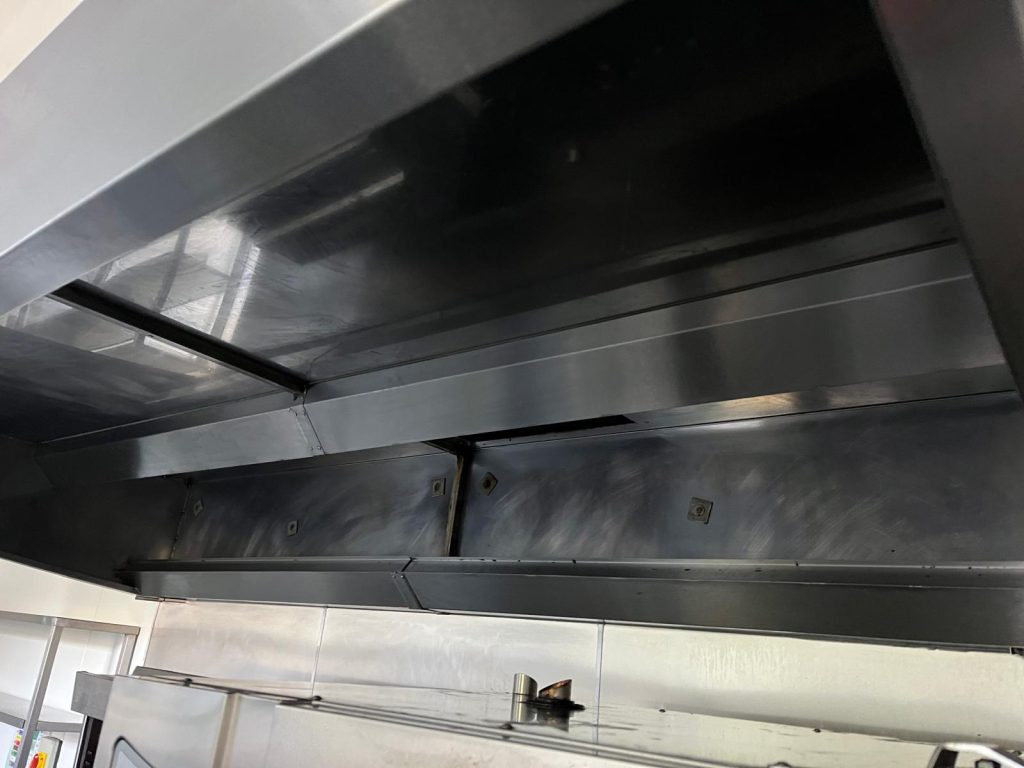
Historic EC Cleaners project imagery shows an extract fan in a commercial kitchen system. It is not presented as a diagnosis of the cause of weak extraction at another site.
What should you record before the problem is investigated?
- The symptom. Note weak pull, smoke spillage, heat, noise, vibration, odours or any other change.
- When it started. Record whether the issue appeared suddenly or developed gradually.
- Recent kitchen changes. Include new appliances, a changed menu, increased cooking volume or altered opening hours.
- Fan behaviour. Note whether the fan starts normally, changes speed, stops intermittently or sounds different.
- Recent maintenance. Find the latest cleaning, inspection or mechanical service record.
- Known access problems. Keep previous inaccessible sections or exclusions visible.
- Photographs or video. Useful evidence can help show smoke escape, fan behaviour or the condition of accessible components.
Which contractor route may be appropriate?
Grease contamination
Where inspection evidence points to grease accumulation affecting the extract route, a competent kitchen extract cleaning contractor may be required.
Fan or mechanical fault
Where the symptoms point to motor, bearings, drive, balance, controls or other mechanical problems, use a competent mechanical or ventilation specialist.
Airflow or replacement air problem
Where the issue concerns extract volume, capture, make-up air or wider ventilation performance, competent ventilation assessment may be needed.
Access problem
If the fan or duct route cannot be reached for inspection or maintenance, access may need to be resolved first.
Unclear previous report
If earlier work does not make the system, readings, exclusions or recommendations clear, organise the evidence before issuing another instruction.
Contractor appointment
Once the workstream is understood, check that the contractor has the competence, insurance and access capability for the actual job.
Related kitchen extract problem guidance
This page focuses on weak fan pull. The parent page covers the wider range of kitchen extraction problems and routes them into the relevant cleaning, ventilation, access or evidence workstream.
Commercial kitchen extractor fan problems: frequently asked questions
Why is my commercial kitchen extractor fan not pulling properly?
Weak pull can be caused by several different issues. Grease contamination, blocked filters and duct restrictions can affect performance, but fan condition, controls, replacement air, changes to cooking equipment and the wider ventilation design can also be involved.
Can dirty ductwork reduce kitchen extract performance?
Yes. HSE guidance warns that fat residues and blocked air inlets can lead to loss of ventilation efficiency and increased fire risk. Cleaning may therefore be relevant where contamination is restricting the system, but it should not be assumed to be the only possible cause.
Can poor replacement air make an extractor fan seem weak?
Yes. A kitchen extraction system removes large volumes of air and that air must be replaced. HSE guidance says ventilation design should provide suitable make-up air. Inadequate or poorly arranged replacement air can contribute to poor capture and uncomfortable conditions.
Why is the fan running but smoke is still escaping from the canopy?
The fan can be running without the canopy achieving effective capture. Possible causes include inadequate extract volume, replacement air problems, contamination, duct restrictions, changes to cooking equipment or a system that is no longer matched to the cooking load.
Should I turn the fan speed up if extraction feels weak?
Do not alter system settings without understanding the installation. Changes to fan speed or make-up air can affect system balance and, where gas or solid fuel appliances are involved, safe combustion and carbon monoxide risk. Use competent technical advice.
What if the fan is noisy or vibrating as well as pulling poorly?
Noise or vibration can point to a mechanical or airflow issue such as fan condition, bearings, mounting, balance, contamination or turbulence. HSE guidance says effective catering ventilation should be quiet and vibration free.
Who should investigate a commercial kitchen extractor fan problem?
The appropriate contractor depends on the evidence. Grease contamination may call for a competent kitchen extract cleaning contractor, while fan, airflow, controls, replacement air or design issues may require a competent ventilation or mechanical specialist.
Is the kitchen extractor fan running but not pulling properly?
Send the symptoms, site details and the latest maintenance information. EC can help organise the requirement so contamination, fan condition, airflow, replacement air and access are not mixed together before the appropriate independent specialist is approached.
Responsibility statement:
EC Cleaners Network is operated by Search and Submit Ltd. Search and Submit Ltd does not inspect, clean, test, survey, design, remediate, certify or technically approve kitchen extraction or ventilation systems. Independent appointed contractors and competent professionals remain responsible for technical assessment, safe working, quotations, physical delivery, reporting, certification and professional conclusions within their appointed scope.
TR19® Grease and TR19® Air are BESA specifications. References are descriptive and no BESA endorsement of or affiliation with EC Cleaners Network is claimed.