
EC Cleaners Network · Kitchen Extract Problems
A kitchen extract fan that becomes noisy or starts vibrating should be investigated rather than treated as a normal sign of age.
Possible causes include grease contamination, bearings, balance, mounting, drive components, casing, duct connections and airflow turbulence. Cleaning may be relevant where contamination is involved, but mechanical diagnosis and repair remain separate workstreams.
Has the fan started making a different noise or vibrating?
Send the site location, when the change started, whether extraction performance has also changed and any recent cleaning, fan service or kitchen alteration. Photographs or video can help where they can be obtained safely.
Search and Submit Ltd uses your details to respond and coordinate the enquiry, including sharing relevant information with appropriate independent specialists. Read our Privacy Policy. Please omit unrelated personal or sensitive information.
What can cause a commercial kitchen extract fan to become noisy or vibrate?
HSE guidance says an effective catering ventilation system should be quiet and vibration free. Its wider local exhaust ventilation guidance identifies the fan itself, blade design, bearings, mounting, casing, duct connection and airflow turbulence as potential sources of noise.
That means a change in sound should not automatically be blamed on dirt or grease. The cause may be mechanical, airflow related, hygiene related or a combination of these.
A new noise is useful evidence. Record what changed before deciding what work to order.
Read the parent guide to commercial kitchen extraction problems →
Common causes of noise or vibration
Bearings or other moving components
Wear in bearings or other rotating components can create rumbling, grinding, rattling or vibration. Mechanical assessment is needed to establish the actual fault.
Fan balance
A fan that is out of balance can generate vibration and noise. Contamination may contribute in some cases, but damaged or worn components can also be involved.
Grease contamination
Grease on fan components can affect condition and balance. Where contamination is significant, cleaning may form part of the corrective work.
Mounting or support problems
Loose, worn or unsuitable mountings can transmit vibration into the building structure or connected ductwork.
Duct connection problems
HSE LEV guidance identifies duct connections as one possible source of fan noise and vibration. The noise may therefore be transmitted or amplified away from the fan itself.
Airflow turbulence
Sharp bends, abrupt changes in duct size, internal obstructions or high air velocities can create turbulence and additional noise.
Drive or motor condition
Where the installation uses belts, drives or other mechanical transmission components, wear or adjustment problems can create noise and affect performance.
Can grease contamination make a fan noisy?
Yes, contamination can contribute. Grease can accumulate throughout the extract route, including on fan components. Where deposits affect rotating parts, they may influence balance, cleanliness or general condition.
The important point is not to stop the diagnosis there. A noisy fan may also have worn bearings, a mechanical fault, poor mounting or airflow problems. Cleaning can remove contamination from the agreed accessible scope, but it cannot repair every mechanical defect.
What does the type of noise tell you?
The sound can help describe the symptom, but it should not be used as a remote diagnosis. A competent contractor may ask whether the noise is new, constant, intermittent, linked to fan speed or accompanied by reduced extraction.
Rattling
May justify checking mountings, loose components, casing, duct connections and other mechanical parts.
Grinding or rumbling
Can justify checking bearings and rotating components promptly.
High-pitched noise
May be associated with airflow, drive components, fan speed or other mechanical conditions.
Rhythmic vibration
Can justify checking fan balance, rotating components, contamination and mountings.
These descriptions are only ways of recording the symptom. They do not establish the cause without inspection.
Can ductwork create or transmit the noise?
Yes. HSE’s local exhaust ventilation guidance says noise can come from turbulence caused by sharp bends, sudden changes in cross-section, internal duct features, high velocities and vibration generated elsewhere and transmitted through hoods or ductwork.
This is why the investigation should not always stop at the fan housing. The connected duct route, flexible connections, supports and nearby system components may also need to be considered.
Has extraction performance changed as well?
Noise and weak extraction occurring together provide a different picture from noise alone. If smoke is escaping, airflow feels weaker or the kitchen has become hotter at the same time, the investigation may need to include fan duty, controls, filters, duct restrictions and replacement air.
Look at the fan in the context of the complete system
The fan sits within a wider extract route. Depending on the installation, that can include filters, canopy, plenum, ductwork, risers, fan, discharge, controls and the access required for inspection and maintenance.
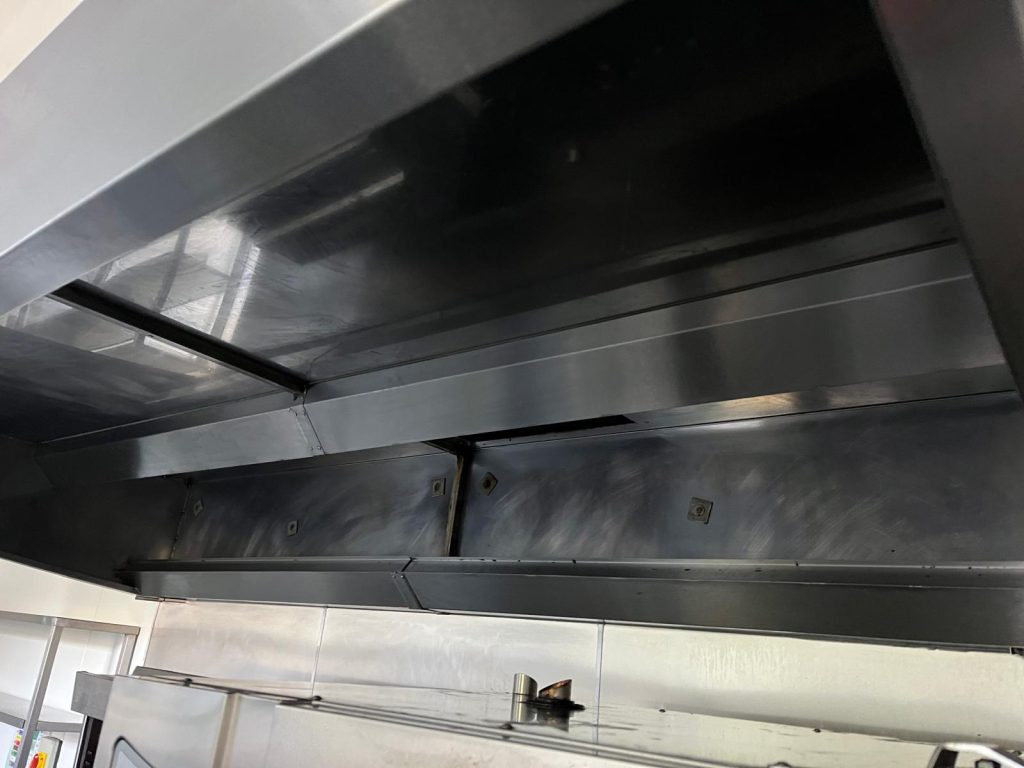
Historic EC Cleaners project imagery illustrates an extract fan within a commercial kitchen system. It is not presented as evidence of a mechanical fault at the photographed premises.
What should you record before the fan is investigated?
- When the noise started. Record whether the change was sudden or gradual.
- The type of noise. Describe rattling, grinding, rumbling, high-pitched sound or another clear symptom.
- Where vibration is felt. Fan housing, roof, ductwork, ceiling, wall or another location.
- Whether airflow changed. Note weaker pull, smoke spillage or other performance changes.
- Recent work. Record any cleaning, mechanical service, control change or duct alteration.
- Operating pattern. Note whether the problem changes with fan speed or during busy cooking periods.
- Visual evidence. Photographs or video can help where they can be obtained safely.
Which contractor route may be appropriate?
Grease contamination
If contamination is affecting the fan or nearby extract route, a competent kitchen extract cleaning contractor may be required.
Mechanical fan problem
Bearings, motors, drives, balance and other mechanical faults should be assessed by a competent ventilation or mechanical specialist.
Airflow or turbulence problem
If noise is linked to duct geometry, air velocity, fan duty or wider ventilation performance, competent ventilation assessment may be needed.
Access problem
If the fan or connected ductwork cannot be reached safely for inspection or maintenance, access may need to be resolved first.
Unclear previous maintenance
If the recent cleaning or service report does not show what was inspected, cleaned or excluded, organise the evidence before issuing another instruction.
Contractor appointment
Once the workstream is clear, check that the contractor’s competence and insurance match the technical requirement.
When does a noisy fan need prompt attention?
A sudden major change in sound, strong vibration, visible movement, loss of extraction or another sign of equipment distress deserves prompt competent assessment. Follow the site’s safe operating procedures and do not attempt improvised access, dismantling or adjustment while equipment is running.
Where gas or solid fuel appliances depend on the ventilation system, poor or unreliable extraction can have additional safety implications. HSE identifies unreliable or broken ventilation as a risk factor in commercial catering installations.
Related kitchen extract problem guidance
This page focuses on fan noise and vibration. The related pages cover weak pull, smoke spillage, persistent odour, grease leakage and the wider range of extraction problems.
Commercial kitchen extract fan noise: frequently asked questions
Why is my commercial kitchen extract fan noisy?
A noisy extract fan can have several possible causes, including bearings, mounting, balance, contamination, drive components, casing, duct connections or airflow turbulence. The exact cause should be established by a competent ventilation or mechanical contractor.
Why is my kitchen extractor fan vibrating?
Vibration can come from the fan assembly, mounting, balance, worn components, contamination, duct connections or airflow conditions. HSE guidance says effective catering ventilation should be quiet and vibration free.
Can grease build-up make an extract fan noisy?
It can contribute. Grease contamination on fan components can affect condition and balance, but noise should not be assumed to be a cleaning-only issue. Mechanical condition and airflow should also be considered.
Should I switch the fan off if it suddenly becomes very noisy?
If there is an immediate safety concern, follow the site’s safe operating procedures and obtain competent advice. Do not attempt unsafe access, dismantling or adjustment while the equipment is operating.
Can ductwork cause fan noise?
Yes. HSE LEV guidance identifies duct connections, turbulence, sharp bends, changes in cross-section and high air velocities as possible sources of noise or vibration in extraction systems.
Can cleaning fix fan vibration?
Cleaning may help where contamination is affecting fan components, but it cannot repair worn bearings, damaged components, poor mounting, drive faults or other mechanical defects.
What information should I send when reporting a noisy kitchen extract fan?
Send the site location, when the noise or vibration started, whether extraction performance has changed, photographs or video where safe to obtain, the latest cleaning or mechanical service report and details of any recent work or kitchen changes.
Has the commercial kitchen extract fan become noisy or started vibrating?
Send the site details, symptoms and recent maintenance information. EC can help organise the requirement so contamination, fan condition, airflow, ductwork and access are considered separately before the appropriate independent specialist is approached.
Responsibility statement:
EC Cleaners Network is operated by Search and Submit Ltd. Search and Submit Ltd does not inspect, clean, test, survey, design, remediate, certify or technically approve kitchen extraction or ventilation systems. Independent appointed contractors and competent professionals remain responsible for technical assessment, safe working, quotations, physical delivery, reporting, certification and professional conclusions within their appointed scope.
TR19® Grease and TR19® Air are BESA specifications. References are descriptive and no BESA endorsement of or affiliation with EC Cleaners Network is claimed.